Finding Faith Through Tragedy:
A Pastor's Honest Guide
There is a question I have heard more times than I can count, sitting across from people in my office at St. John's Presbyterian Church in southwest Houston.
The question usually comes a few weeks after the tragedy. After the funeral. After the food stops showing up at the door. After the friends who flew in from out of town have gone back to their lives. The question comes in the quiet, and it sounds something like this: "Pastor Jon, I want to believe God is still there. But I am not sure I do anymore."
I want to talk honestly about that question. Because it is one of the most important questions a human being can ask. And it deserves a better answer than it usually gets.
What Tragedy Does to Faith
Tragedy does not destroy faith gradually. It hits all at once.
One day you are living your life, going to church on Sunday, saying your prayers, trusting that God is good and the world makes a certain kind of sense. And then something happens. A phone call. A diagnosis. An accident. A loss so sudden and so complete that the whole structure of your life shifts underneath you.
And the faith that felt solid the day before suddenly feels like it was built on something thinner than you realized.
This is not a sign that your faith was fake. It is a sign that your faith is being tested in the only way faith ever really gets tested, by something that actually costs you something.
C.S. Lewis wrote about this after his wife Joy died of cancer. He kept a journal in the weeks after her death, and what he wrote was raw and honest and sometimes frightening. He described his faith feeling like a door slammed in his face. He described God feeling absent in exactly the moments when he needed God most.
Lewis was one of the most brilliant Christian thinkers of the twentieth century. He had written entire books defending the faith. And tragedy still shook him to his foundation.
That should tell us something. Tragedy is not a problem that better theology prevents. It is an experience that better theology helps us survive.
The Question Underneath the Question
When someone tells me they are struggling to find faith after a tragedy, I have learned to listen for the question underneath the question.
Sometimes the real question is "Did I do something to deserve this?" The idea that tragedy is punishment is one of the oldest and most persistent wrong ideas in human religious history. Job's friends believed it. They looked at Job's suffering and assumed he must have sinned. God, at the end of that story, told them directly that they were wrong.
Tragedy is not a report card. Bad things happen to good people. Good things happen to bad people. The rain falls on the just and the unjust alike. Jesus said that himself in the Sermon on the Mount. The universe does not operate on a simple cause and effect system where your suffering is a direct consequence of your moral failures.
If you are carrying guilt alongside your grief, wondering what you did to bring this on yourself, I want to say this as directly as I can: let that go. It is not the truth.
Sometimes the real question is "Does God actually care about me?" This one is harder. Because if God is all-powerful and could have prevented the tragedy and did not, what does that say about how much God values you?
This is the oldest theological question in the world. It does not have a simple answer. What I can tell you is what I have seen in thirty years of pastoral ministry. I have sat with people in the worst moments of their lives, people who had every reason to conclude that God had abandoned them, and I have watched something happen in those moments that I cannot explain any other way except to say that God showed up. Not to take the pain away. But to be present inside it.
That is not a philosophical argument. It is testimony. And testimony carries its own kind of weight.
Why Tragedy and Faith Do Not Have to Be Enemies
Here is something that surprised me early in my ministry and has never stopped being true.
The people with the deepest faith I have ever known are almost always people who have been through the hardest things.
Not the people who have had easy lives and found God easy to believe in. The people who have walked through something terrible and came out the other side still trusting. Their faith is not naive. It has been tested and it held. And that tested, surviving faith is a completely different thing from the untested version.
There is a word for this in the Christian tradition. Refinement. The image comes from metalworking. You put metal in a fire not to destroy it but to burn away the impurities and leave what is actually valuable. The fire is not punishment. The fire is process.
I am not saying God sends tragedy to refine us. I want to be careful here because that idea has been used to say terrible things to suffering people and I will not add to that. What I am saying is that tragedy, when we walk through it honestly and do not run from it, has a way of burning away the things in our faith that were never really solid to begin with. The comfortable assumptions. The easy answers. The version of God that existed mainly to make us feel safe.
And what sometimes remains, after the fire, is something sturdier. A faith that knows what it costs. A trust that has been earned rather than assumed.
The Honest Truth About Doubt
Doubt is not the opposite of faith. It is part of faith.
Every person of serious faith I have ever known has doubted. The question is not whether you will doubt but what you do with the doubt when it comes.
There are two unhelpful responses to doubt. The first is to pretend it is not there. To perform confidence you do not actually have, to say the right things in church and keep the real questions locked away somewhere private. This approach tends to make the doubt grow. Things that live in the dark tend to get larger than they actually are.
The second unhelpful response is to treat doubt as a verdict. To decide that because you are doubting, faith must be finished. That the questions mean the answer is no.
The more honest and more useful response is to bring the doubt into your relationship with God directly. To say out loud, to God, "I am not sure I believe you are there right now. But I am talking to you anyway, because I have nowhere else to go."
That is actually faith. Wounded, honest, struggling faith. But faith.
The Psalms model this constantly. Psalm 88 is the darkest Psalm in the Bible. It ends with the word "darkness." There is no resolution, no turn toward hope at the end. Just a person in the dark, still talking to God. That Psalm made it into Scripture. God preserved it. Which means God is not embarrassed by that kind of prayer.
What Helped the People I Have Walked With
Over the years I have watched people find their way through tragedy and back toward faith. I want to share what I have actually seen work, not what sounds good in theory.
Small, honest prayer helped more than polished prayer. People who kept talking to God even when they were angry at God, even when they were not sure God was listening, seemed to come through with their faith more intact than people who went silent. "I am furious at you right now" is a prayer. "I do not understand what you are doing" is a prayer. God is big enough to handle it.
Community that did not flinch helped more than community that tried to fix things. The friends who showed up and sat down and did not immediately try to explain the tragedy or silver-line it were the ones who actually helped. Presence is more powerful than answers in the middle of grief.
Time in Scripture helped, but not in a forced way. Reading the Psalms of lament, in particular, has a way of making grieving people feel less alone in their struggle. When you read Psalm 22 and realize that the person who wrote it was going through something that sounds very much like what you are going through, something shifts. You are not the first person to feel abandoned by God. You are not the first person to cry out into what feels like empty air. And that company, across three thousand years of human suffering, is its own kind of comfort.
Letting grief take the time it actually takes helped more than trying to rush through it. There is no timeline for finding faith after tragedy. Some people find their way back in months. Some people take years. Some people find that what they come back to is different from what they had before, deeper and less comfortable and more honest. All of that is okay.
What St. John's Has Learned About Walking With Grieving People
At St. John's Presbyterian Church in southwest Houston, we have been walking with grieving families for a long time. We are a small congregation, about 250 members, which means when someone is hurting we actually know about it. Nobody falls through the cracks because the cracks are not big enough to fall through.
We have learned some things about what grieving people actually need from a church community.
They need to be able to come on a Sunday morning and not have to pretend they are fine. Our worship includes lament. We read the hard Psalms alongside the joyful ones. We leave room for honesty in the presence of God rather than performing a tidier version of our spiritual lives than the one we are actually living.
They need follow-up that goes past the first few weeks. It is easy to show up for the funeral. It is harder to show up three months later on a random Tuesday when the grief has gone quiet but not gone. We try to do the harder thing.
They need permission to have questions that do not have answers. We are a theologically serious congregation, which means we do not offer easy answers to hard questions. We sit with the questions. We trust that God is large enough to hold both our faith and our uncertainty at the same time.
If you are in the Houston area and you are walking through a season of tragedy and you are looking for a community that can hold that with you, we would genuinely be glad to have you with us. Sunday worship is at 11:00 AM. Sunday Bible Study is at 9:30 AM. We are located at 5020 West Bellfort Avenue in southwest Houston. You can learn more at stjohnspresby.org.
A Resource for the Journey
Several years of sitting with grieving and struggling people eventually pushed me to write down what I had learned. The result is
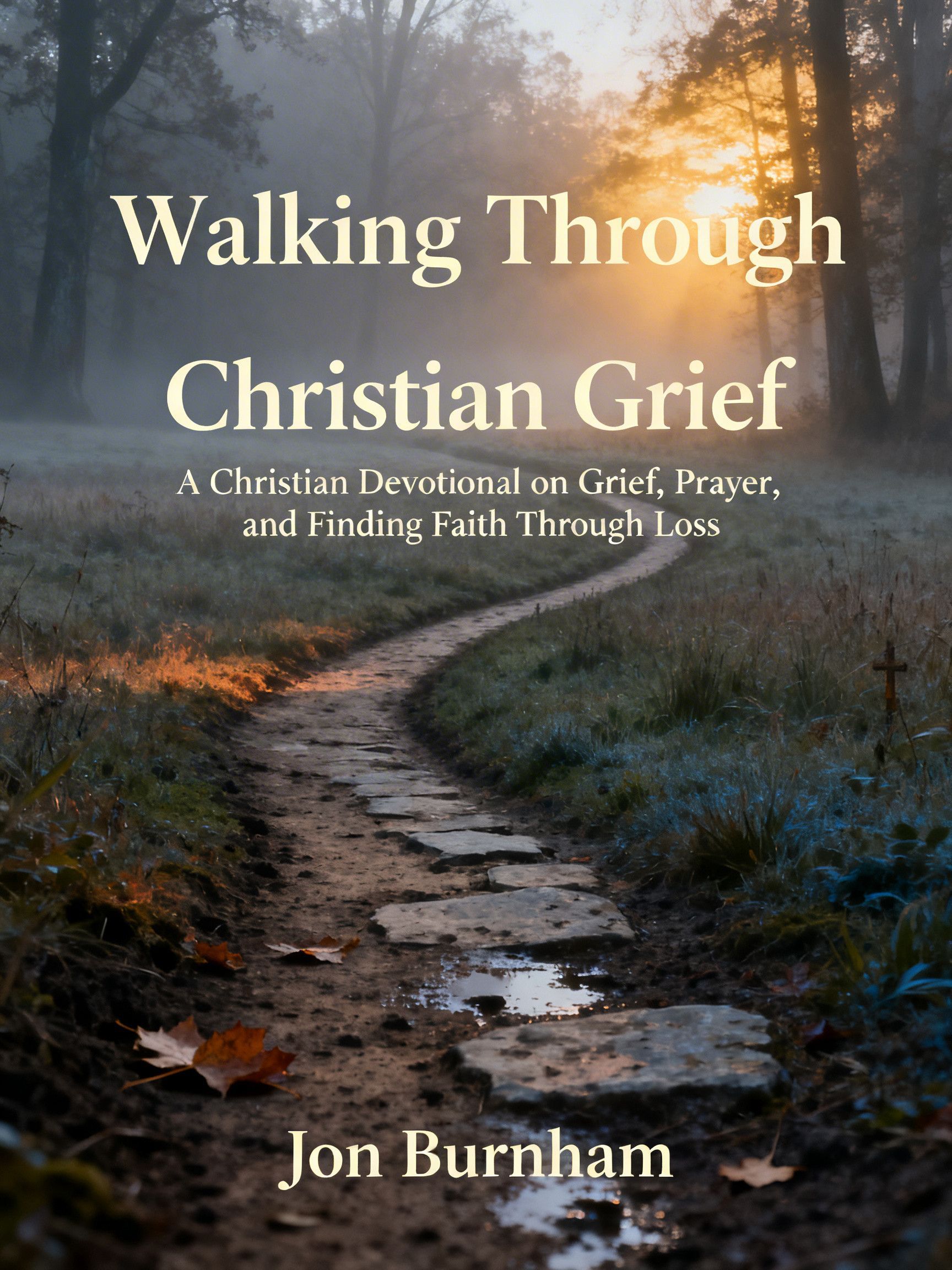
Walking Through Christian Grief: A Christian Devotional on Grief, Prayer, and Finding Faith Through Loss.
The book does not offer easy answers. I do not know how to write that book honestly because easy answers are not what grieving people need. What the book offers is honest companionship for the journey. Twenty chapters that walk through the experience of loss from the raw early days through the long middle stretch, plus a 30-day devotional for the days when you need something short and anchoring rather than a full chapter.
It is available on Amazon in paperback, hardcover, Kindle, and audiobook. If you are in the middle of a hard season right now, or if you know someone who is, it was written for exactly that moment.
The Long View
I want to close with something I have seen enough times to trust it.
People who walk through tragedy and keep walking, who do not give up on God or on life or on the possibility that something good can still come, those people often arrive somewhere they could not have reached any other way.
Not because the tragedy was good. It was not. Loss is loss. Pain is pain. I will not reframe your suffering into a gift you should be grateful for.
But because something happens in the walking through. Something gets built that could not have been built any other way. A capacity for compassion that comes from having needed compassion yourself. A tolerance for uncertainty that comes from having lived inside it. A faith that has been through fire and knows it can survive fire.
That is not the destination you would have chosen. But it is a real destination. And people arrive there.
You are not at the end of your story. You are in the middle of a very hard chapter. And the God who spoke light into darkness and raised the dead on the third day is not finished with you yet.
Keep walking. You are not walking alone.
Peace,
Jon B.