Church Architecture Houston: How St. John's Presbyterian Sanctuary Creates Sacred Space
When you pull into the parking lot at St. John's Presbyterian Church on West Bellfort, you're looking at a building that tells a story. Built in 1965, our sanctuary represents something specific about mid-century American Christianity, particularly in suburban Houston. And if you understand what you're seeing, you'll discover that our building does more than just keep the rain off during worship.
The architecture actively prepares you to meet God.
I'm Jon, pastor here at St. John's, and I've spent years watching people walk into this building. I've noticed something interesting. The architecture works on people before they even realize it. By the time someone sits down in a pew, the building has already begun its quiet work of shifting their attention from the chaos of Houston traffic to the presence of the Holy.
Let me show you how.
Why Church Buildings Matter More Than You Think
Before we talk about St. John's specifically, we need to address something that a lot of modern Christians miss. Physical space matters for worship.
This isn't about superstition or magic. It's about the simple fact that we are embodied creatures. We experience God through our bodies, in physical places, at specific times. The incarnation itself teaches us this. God didn't send us an email. He showed up in a body, in a place, at a particular moment in history.
So when we gather for worship, the space we gather in shapes our experience. A basketball arena creates one kind of experience. A living room creates another. A traditional sanctuary creates something else entirely.
At St. John's, we inherit a tradition of church architecture that takes this seriously. Our building was designed during an era when Protestant churches were thinking carefully about how physical space could support authentic worship without the distractions of entertainment or spectacle.
The Honest Simplicity of Mid-Century Church Design
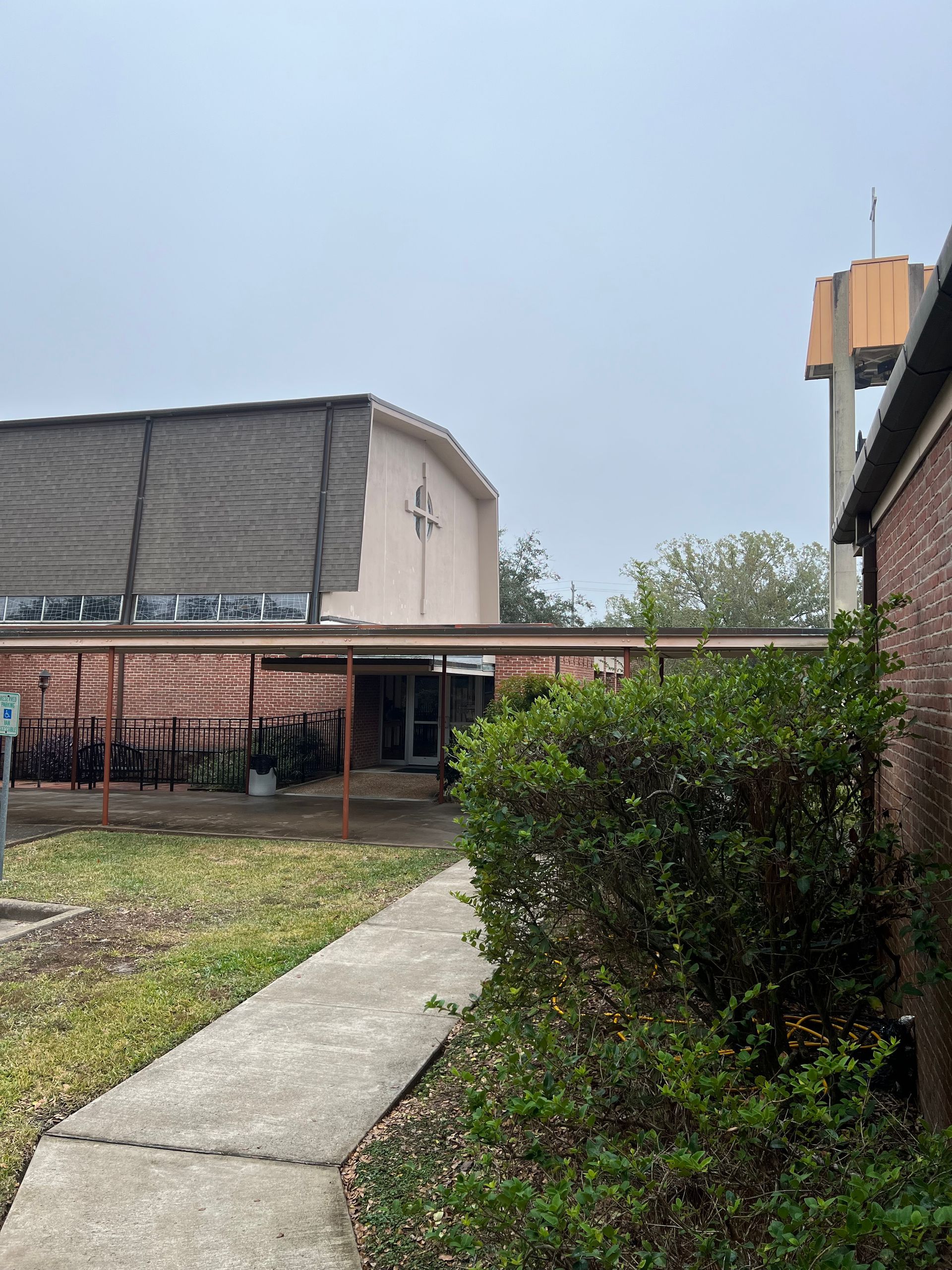
Look at a photograph of St. John's from the parking lot. You'll notice it doesn't try to look like a medieval cathedral. It doesn't have gargoyles or stone towers or flying buttresses. It looks like what it is: a mid-century suburban building designed for a community that valued substance over show.
This was intentional.
The architects who designed churches in the 1960s were part of a movement that wanted to strip away unnecessary ornamentation and get back to basics. They asked a simple question: What does a building actually need to create space for encountering God?
Their answer: Not as much as you might think.
What you see at St. John's is brick, wood, simple lines, and thoughtful proportions. The materials are honest. The brick is brick, not brick-shaped foam. The wood is wood, not plastic veneer. The building doesn't pretend to be something it isn't.
This reflects a Presbyterian value that runs deep in our tradition. We believe that God is found in truth, not illusion. In substance, not surface. The building expresses this before anyone says a word.
How the Roof Creates Shelter for Your Soul
The most prominent feature of St. John's exterior is the steep, dramatic roofline. It's high and angular, covered in dark shingles, and it dominates the profile of the building.
There's a reason for this.
A tall roof does something to human psychology. It creates a sense of shelter that goes beyond just keeping the weather out. When you see that steep peak, something ancient in your brain recognizes the shape of protection. It's the same response you have to a tent, a cave, a covered porch during a rainstorm.
The roof says, without words: You can be safe here.
This matters more than you might realize for worship. Many people come to church carrying burdens. They're anxious about work, worried about family, stressed about money, grieving losses. They need a place that feels like refuge before they can open themselves to God's presence.
The steep roof creates that sense of refuge. It makes the building feel less like an institution and more like a covering. Not a fortress keeping the world out, but a shelter inviting you in.
The Covered Walkway: A Transition from Rush to Rest
Now look at the entrance. There's a long, covered walkway that connects the parking lot to the sanctuary door. It has a metal roof and open sides. On rainy days, it keeps you dry. But that's not its primary purpose.
The walkway is a threshold.
Think about what happens when you come to church on Sunday morning. You've been driving in Houston traffic. Your mind is full of the week's concerns. You're thinking about what you need to do this afternoon. You're basically still in the mode of getting things done, checking boxes, moving efficiently from one task to the next.
That's not the right mindset for worship.
The walkway solves this problem through simple geometry. It's long, so you have to walk slowly through it. The ceiling is low, so you physically can't rush. And because it's open on the sides, you're outside but also sheltered, caught between the parking lot and the sanctuary door.
This creates a transition. You enter the walkway as someone hurrying to make it on time for the service. You exit it as someone ready to slow down and pay attention. The architecture forces you to take a breath.
I've watched this happen hundreds of times. People walking quickly from their cars, then slowing down as they enter the covered walkway. By the time they reach the door, their body language has changed. They're moving differently, breathing differently, present differently.
The building has already begun the work of worship before anyone sings a hymn.
The Columbarium: Walking Past the Saints Who Went Before
Here's the feature that some visitors find startling at first. Right next to the entrance, built into the ground next to the brick wall, is our columbarium. This is where we place the cremated remains of church members who have died.
It's basically a wall of niches, each marked with a name and dates, right there where you walk past on your way into worship.
Some modern churches hide their cemeteries out back or skip them entirely. We put ours at the front door. This is a deliberate choice that reflects something important about Christian faith.
When you walk past the columbarium, you're reminded of something crucial: You're not the first person to walk through this door. Generations of believers have gathered here before you. They sang the same hymns, prayed the same prayers, struggled with the same doubts, and found the same grace.
And they're finished now. Their race is run. They've gone ahead of us into the presence of God.
This puts your own concerns in perspective. Whatever you're bringing to worship today, whatever feels overwhelming or urgent or devastating, it's temporary. You are temporary. And that's okay, because the community of faith stretches backward and forward, connecting you to something larger than your own brief moment.
The columbarium also reminds us that St. John's is a real community with a real history. We're not a church that started five years ago with slick marketing and no roots. We're a congregation that has been gathering since 1956, and we take seriously our connection to the saints who built this place and sustained it through decades of faithful service.
When you walk into worship at St. John's, you're joining a stream of witnesses. The architecture makes this visible.
Simple Materials, Serious Faith
Let's talk about the brick.
St. John's is built from regular, reddish-brown brick. No marble. No granite. No expensive stone imported from quarries in Italy. Just brick, like thousands of other Houston buildings from the same era.
This isn't a compromise. It's a statement.
The brick says: We're not trying to impress you with wealth or status. We're here for something more important than showing off. The money we could have spent on fancy materials went instead into mission work, supporting ministries, helping people in real need.
This reflects a core Presbyterian conviction about how resources should be used. We believe in faithful stewardship, not extravagant display. We believe in substance, not show. We believe that the church's real beauty comes from the lives being transformed, not the building being photographed.
The honest brick at St. John's tells you what kind of congregation this is. We value depth over spectacle, mission over ornamentation, authentic community over impressive appearances.
You can see this in the whole design. The wood beams inside the sanctuary are real wood, not decorative. The pews are simple, sturdy, built to last. The windows let in natural light without stained glass fantasies. Everything in the building says: We're here for the real work of Christian formation, not to create an Instagram moment.
How Architecture Supports Authentic Worship
Now let's connect this to what happens when we actually gather for worship.
At St. John's, Sunday morning worship starts at 11:00 AM. By that time, the building has already done significant work on everyone walking through the door. The roof has created a sense of shelter. The walkway has slowed people down. The columbarium has connected them to the larger story of faith.
When worship begins, the sanctuary architecture continues this work.
The ceiling is high but not overwhelming. It creates a sense of space for God's presence without making people feel insignificant. The natural light from the windows connects us to God's creation even as we focus on God's word. The simple lines keep attention on what matters: the gathered community, the Scripture, the proclamation of the gospel.
There are no screens competing for attention. No elaborate staging. No production elements designed to manufacture emotion. Just a pulpit, a communion table, a baptismal font, and a gathered community.
This creates space for something that larger, more spectacular churches struggle with: authentic encounter with God that doesn't depend on constant stimulation.
At St. John's, you can actually hear yourself think. You can pray without competing with production values. You can listen to Scripture without wondering what visual element is coming next. The architecture supports contemplation rather than entertainment.
This is increasingly rare in Houston's church landscape, where many congregations have adopted arena-style worship with massive screens and concert-level production. Those approaches aren't wrong, but they create a different kind of experience. They're designed for crowds, not community. For spectacle, not reflection. For impact, not depth.
Our building is designed for adults who want to think, pray, listen, and engage seriously with God's word. The architecture itself says: This is not a show. This is worship.
What Mid-Century Church Architecture Reveals About Presbyterian Values
The design choices in St. John's building reflect theological convictions that run deep in Presbyterian tradition.
First, simplicity. John Calvin, the founder of Reformed theology, was deeply suspicious of elaborate church decoration. He worried that beautiful buildings would become idols, distracting people from God. Presbyterian churches have historically embraced simple design as a way of keeping focus on what matters.
Second, accessibility. Our brick building with its covered walkway and simple design says: Everyone is welcome here. You don't need to dress up to fit in. You don't need to be impressed by wealth or status. This is a place for regular people seeking God.
Third, substance. The honest materials and straightforward design reflect Presbyterian emphasis on truth over appearance. We care more about the real work of transformation than about looking successful or impressive.
Fourth, connection to history. The columbarium and the traditional architectural style connect us to centuries of Christian worship. We're not inventing Christianity from scratch each Sunday. We're joining a long tradition of faith.
These values shape everything we do at St. John's, not just our building design. They shape how we do Bible study (depth over superficiality), how we approach mission (relationships over projects), how we build community (genuine fellowship over programmed events).
The building expresses these convictions before anyone speaks them.
Why Smaller Sanctuaries Create Stronger Community
Here's something worth noticing about St. John's sanctuary. It's not huge. We can fit about 250 people when we're really packed in, but most Sundays we have 75 or so gathered for worship.
This creates something that massive sanctuaries can't: intimacy.
In our sanctuary, you can see everyone else who's gathered. You notice when someone's missing. You hear the baby crying in the back. You recognize the person singing off-key three rows ahead. This isn't a bug. It's the main feature.
Real Christian community requires knowing and being known. The architecture at St. John's supports this by creating a space where you can't hide in anonymity. You're part of a visible, countable community of people who show up week after week.
This matters for spiritual formation in ways that are hard to quantify. When you're part of a small congregation in a modest sanctuary, you can't just consume worship services like entertainment. You're needed. Your presence matters. Your voice in the hymns contributes to the sound of the whole. Your absence is noticed.
The building's scale reinforces our commitment to authentic relationship over impressive numbers. We're not trying to pack in thousands of people. We're trying to form a community where people actually know each other's names, stories, struggles, and joys.
How St. John's Fits Into Houston's Church Landscape
Houston has an incredible variety of churches. We have massive megachurches with campuses that look like shopping malls. We have storefront churches in strip centers. We have historic downtown cathedrals. We have contemporary churches meeting in school cafeterias.
St. John's sits in a specific category: the established neighborhood church with a real building and a real history.
This matters for people who are looking for something different from Houston's dominant megachurch culture. Many adults today grew up in large churches with big production values but felt anonymous. They want something more intimate. More real. More focused on substance than spectacle.
Our building signals that we offer this alternative. When you see St. John's from West Bellfort, you know immediately that this isn't a megachurch trying to be everything to everyone. This is a established congregation that has been doing serious ministry for decades in a real community.
The architecture tells you what kind of church this is before you meet anyone. It says: We value history. We prioritize substance. We create space for genuine encounter with God. We're rooted in a specific place and committed to a specific community.
For adults who are tired of church-as-entertainment and hungry for church-as-formation, this is exactly what they're looking for.
Practical Details for Visiting St. John's
If you're considering visiting St. John's Presbyterian Church, here's what you need to know about finding us and what to expect.
We're located at 5020 West Bellfort Avenue in southwest Houston. We serve the Westbury, Meyerland, and Bellaire neighborhoods. Parking is straightforward in our lot, and you'll walk through that covered entrance I described to reach the sanctuary.
Sunday worship starts at 11:00 AM. We use traditional Presbyterian liturgy with hymns from the Glory to God hymnal. No screens, no band, no production elements. Just a gathered community worshiping God with Scripture, prayer, preaching, and song.
Before worship, we have Bible study at 9:30 AM for adults who want to dig deeper into Scripture. We also have Children's Sunday School during the worship service, though parents are welcome to keep kids with them in the sanctuary. We have a quiet area in the back with a rocking chair and activities if families need it.
The building itself will do some of the work of preparing you for worship. Let it. Walk slowly through the covered entrance. Notice the columbarium. Let the sanctuary's simple beauty turn your attention toward God rather than toward production values or entertainment.
You can call us at (713) 723-6262 if you have questions, or just show up on Sunday morning. We're a small congregation, so you'll definitely be welcomed personally. That's one of the advantages of worshiping in a building designed for community rather than crowds.
What Our Building Says About Who We Are
Buildings reveal values. The choices made in designing and maintaining a church building tell you what that congregation cares about.
At St. John's, our mid-century sanctuary with its honest materials, simple design, and thoughtful details reveals several core commitments.
We believe in substance over show. We'd rather invest in mission work and community formation than in architectural impressiveness. The brick building with its straightforward design reflects this priority.
We believe in authentic worship over entertainment. Our sanctuary creates space for contemplation, not spectacle. There's room to think, pray, listen, and encounter God without constant stimulation.
We believe in community over crowds. Our building's scale supports the kind of intimate fellowship where people actually know each other. You can't be anonymous here, which is exactly the point.
We believe in connection to history. Our columbarium and traditional design link us to generations of faithful Christians who have gone before. We're not starting from scratch. We're joining a long story.
We believe in honest faith. The building doesn't try to manipulate emotions or manufacture spiritual experiences. It simply creates space for God to meet us and for community to form around that encounter.
These values shape everything we do, from Sunday worship to Bible study to mission work in Houston's southwest neighborhoods. The building expresses these commitments, but the real proof comes in the lives being transformed and the community being built.
An Invitation to Experience Sacred Space
Here's what I want you to understand about church architecture and authentic worship: The physical space matters because we are physical creatures seeking to encounter a God who became physical in Jesus Christ.
St. John's sanctuary, built in 1965 with simple materials and thoughtful design, creates space for this encounter. The steep roof provides shelter. The covered walkway creates transition. The columbarium connects us to the communion of saints. The honest brick and wood reflect our commitment to substance over show. The intimate scale supports genuine community.
All of this happens whether you consciously notice it or not. The building works on you. By the time you sit down for worship, the architecture has already begun shifting your attention from the chaos of daily life to the presence of God.
This is what church buildings are for. Not to impress. Not to entertain. Not to compete with other Houston congregations for who has the biggest or fanciest facility. But to create space where transformation can happen.
If you're looking for a Houston church where the building itself supports
authentic worship rather than manufactured experience, where the architecture reflects values of simplicity and substance rather than spectacle, where the scale creates genuine community rather than anonymous crowds, I'd love for you to visit St. John's Presbyterian.
We gather every Sunday at 11:00 AM at 5020 West Bellfort Avenue. Walk slowly through the covered entrance. Notice what the building does to your breathing, your pace, your attention. Let the architecture prepare you for worship.
And then join us in the simple, profound work of encountering God in community with other believers who value depth over flash and substance over show.
The building will help. That's what it's designed to do.
For more information about worship and community life at St. John's Presbyterian Church, visit
stjohnspresby.org or call (713) 723-6262.
Peace,
Pastor Jon Burnham